Classical concert in Wicker Park receives high praises amid microcosm of diverse activities
Amid a microcosm of activities that displayed our community's diversity, Symphony Sounds String Quartet and Wicker Park Choral Singers presented a superb concert in Wicker Park’s Schiller Grove to an enthusiastic audience. The third in the 2012 summer series of four concerts, the string quartet performed works by Bach, Mozart, and Dvořák while the 18-member chorus performed works by Wilbye, Morris, and Britten. The performance on Sun., Aug. 12., was followed by a guided tour of the 10,000 square feet of park garden.
"I feel like I am standing in the middle of George Seurat’s A Sunday Afternoon on the Island of La Grande Jatte," said a man who grew up in Wicker Park, but who had not visited the neighborhood in the last 15 years. "The Park was nothing like this – the park is packed with families and activities - this is really incredible – Wicker Park has its Own Spirit – I am glad to be here again."
Presented by Wicker Park Advisory Council and Wicker Park Garden Club in collaboration with the Chicago Park District with support from WPB SSA and numerous sponsors listed below, the concert drew an audience that was part of the thousands who came to the park for the Farmer’s Market, the playground, a softball game or just to enjoy the environment. Members of the Wicker Park Advisory Council and Wicker Park Garden Club greeted the guests and answered questions about the numerous special events and the programming and park gardens.
In this review, I will address the performance and how the park patrons received it. For background information on the music performed read the concert preview.
The level of performance of both groups was totally top notch in every way. They displayed a sophisticated understanding of each composer’s intent and his historic period’s aesthetics, exciting phrasing and interpretation of the scores, and flawless ensemble work. These ensembles demonstrate the utmost rapport among their members, which results in presentation that is unified, organic, and compelling. Each group showed a great love of the music and obviously enjoyed presenting their interpretations to the audience. They spoke extensively, clearly and in a relaxed fashion about the composers and their compositions before they performed them. The audience said that they appreciated learning more about the composers and their works before they heard them performed. It was a joy to watch and listen to both ensembles. Not many communities have the opportunity to hear such excellent musicians and singers. Wicker Park is very fortunate.
Composed of people of all ages, the audience of about 250 sat in the chairs or on blankets and picnicked for the entire 90-minute concert, while others (about 600) stopped by and listened to one or two of the compositions. Still others sat on the fountain court’s benches, since the string player’s instrument were amplified. The Crusty Punks or Rail Riders moved about and ended up enjoying the concert next to the Charles Wicker sculpture. The sound carried to the Farmer’s Market and the playground on the north side of the park and to softball game on the east side where it blended with a softball game’s enthusiastic outbursts and children playing in their playground. Veteran concertgoers of all ages as well as many families with children, some not that familiar with classical music, attended and enjoyed themselves.
Several of the children at the concert had also attended the August 5th Magic Boat’s music education performance. You can read about that collaboration here. They saw and recognized their artwork hanging behind the musicians. The banner depicts the "train & industrial references" in the last movement of Dvořák’s American String Quartet. The children’s responses to the instruments, singers and the music itself were memorable. I enjoyed watching them curiously observe the instruments and how they were played. Some were drawn to the stage for a closer observation of the instruments and the singers. Others listened attentively and then broke out into a dance. The Bach, Mozart and particularly the Dvořák were favorite choices for the children’s dances. One neighbor said "You know I am not that in love with children – but that child is right on Dvorak’s music – look at her rhythm and energy – just like Dvorak - that is an OK kid."
Symphony Sounds String Quartet opened the performance with Johann Sebastian Bach’s Brandenburg Concerto #3 in G major, BWV 1048 (transcribed for string quartet) and followed with Wolfgang Amadeus Mozart’s String Quartet #4 in C Major K. 157. For these two works the musicians were: Rachelle Elizabeth Puccini (Violin I), Madeline Capistran (Violin II), Ryan Loeckel (Viola), and Sarah Marsh (Cello). The audience appreciated the familiarity of the Bach Brandenburg Concerto and the beautiful energy and lyric qualities of the Mozart that followed it. In Mozart’s work, the operatic drama and phrasing were apparent, especially in the slow movement themes, which were seamlessly transferred from instrument to instrument. The four instrumental voices played with the thematic material in a mesmerizing, almost hypnotic way. Both works were well rehearsed and the group exhibited great rapport in their flawless ensemble work. All players were equally strong, performed the work impeccably and were exciting to watch. These compositions worked very well in the outside setting, mimicking the energy and mood of the surrounding activities of the park, demonstrating Symphony Sound’s expert choices in programming their performances.
Wicker Park Choral Singers, directed by Mark Tomasino, performed three botanic themed works: John Wilbye’s Flora Gave Me Fairest Flowers (1598), Thomas Morley’s O Grief, E'en on the Bud (1594) and Benjamin Britten’s Five Flower Songs (1950). The ensemble sensitively and seamlessly performed Wilbye’s and Morley’s English Madrigals. The clarity of the voices punctuated the words of the Morley text that described the life cycles of all living things: O, grief, e’en on the bud that fairly flowered, the sun hath lowered, and, ah, that breast which Love durst never venture, bold Death did enter. Pity, O Heav’ns that have my love in keeping, my cries, my cries and weeping. This was an especially strong statement when presented outside in the park, during a summer of drought, where life is in perpetual motion - from the earliest bud to the browned, dried flowers that hold the seeds that survive the winter winds and snows to be renewed the following spring when they fall to the soil that is then moistened by the rain.
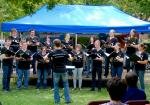
Chorus Director – Mark Tomasino directs the Wicker Park Choral Singers
I will never grow tired of hearing the Britten Five Flower Songs. This is the second time that I have heard Wicker Park Choral Singers perform the composition. Each time you hear the work – you hear something new. Mark Tomasino agreed and said each time he studies and rehearses the work with an ensemble, he experiences new insights into the work. The voices are used in so many ways. Britten paints ever changing, kinetic paintings of voices for us as we proceed through the score. They are paintings of voices that are moving and maneuvering over other paintings of voices that then cascade toward another painting with more voices – that then flow into and over another painting, creating yet another, then we halt, think – then we are moved again by the vocal paint flowing toward and into another painting, then again we proceed with the voice. It depends on where you are when you hear this work, and how long you can focus on hearing it. This to me is reminiscent of a vocalization of a text by Faulkner filled with endlessly long eloquent and colorful sentences. These songs express so much about life: wanting to stop time – stop aging, the beauty and mystery of the night, and the beauty of life cycles and renewal, and the fun and wildness of beginning again. Wicker Park Choral Singers presented this work with incredible artistry.
Symphony Sounds String Quartet then performed Antonín Leopold Dvořák’s Quartet #12, op 96 (American) (1893) as the final work of the day. For this work, the musicians were: Madeline Capistran (Violin I), Rachelle Elizabeth Puccini (Violin II), Ryan Loeckel (Viola) and Sarah Marsh (Cello). Czech composer Antonin Dvořák came from a period (late 19th and early 20th century) where composers were intensely interested in American music, especially American folk music.
Jeannette Thurber invited Dvořák to New York City to serve as the director of the National Conservatory of Music and develop an "American sound." He held that position in New York from 1892-1895. “During his three years at the Conservatory, Dvorák explored what he considered to be the unique folk music of America: the music of Native Americans and the African American spiritual.” He suffered from homesickness and each year took a vacation trip to Spillville, Iowa, a Czech community. In Iowa, he wrote and completed the Quartet #12 (American) in fifteen days. Symphony Sounds excelled in the performance of this work; they had prepared every second to the utmost level. Dvořák wrote the work for four players who could be asked to play as soloists and at the same time, perform as expert ensemble players. Symphony Sounds met his demands. The quartet immersed the audience into the turbulence of the opening movement – Ryan Loeckel (Violist) dramatically introduced us to the main theme.
They then hypnotized us with the lyricism and trans-historic introspection of the haunting second movement’s Adagio. Then, they made a radical change and took us on a fun ride with the rhythmic energy of the third movement Scherzo, and ended with the exuberance of the finale’s fiery Allegro. The second movement was such a treat with the transforming melody seamlessly moving from one voice to the other and then back again. I can’t get this music out of my head – I have heard it every day since the performance, and want to hear them perform it again. I have heard so many recordings and live performances of this work in past years and in preparation for this music series, but never did I hear a recording or performance that matched the breadth and insight of this inspired performance.
The fourth and final performance for the 2012 Summer series will be Sept. 9 from 11 a.m. to 12:30 p.m. in Schiller Grove, Symphony Sounds performs - Antonio Vivaldi’s Fall & Winter from The Four Seasons, Wolfgang Amadeus Mozart’s String Quartet #17 in Bb Major K. 458 (The Hunt), and Philip Glass' String Quartet #3.
Concert sponsors are: WPB SSA, WPB Chamber of Commerce, Cat & Mouse Game Store, Chicago Park District, Friends of the Parks, CCI-Greenheart, Wicker Park Apartments, Friends of Bloomingdale Trail, The Trust for Public Land, Littlerock Construction, Mosaic Church, Urban Encounter, Wicker Park Advisory Council, Wicker Park Garden Club, Our Urban Times, Pipeline.