CPD 12th District: Strategic Decision Support Center up and running
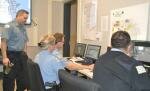
Officer Rivera stands behind Officers Michael Ilkanic, Lisa Ulleweit and Jaime Velez in the Strategic Decision Support Center
The Chicago Police Department's (CPD) 12th District, 1412 S Blue Island Ave, went live March 1 with a center focused on technologies predicting, preventing, combating and responding to crime. They are the 11th station to go online, with all the new technologies. Districts that preceded them are 3,4 5,6, 7, 9, 10, 11, 15 and 25.
Large screens and new computers on the inside, POD crime cameras, Shot Spotter and mobile phones on the outside coupled with several software systems are the components of the new department wide technology initiative. However the 12th District does not have Shot Spotter.
Up and running 24-hours a day in a newly equipped room, there are at least two officers manning the Strategic Decision Support Center (SDSC) 365 days a year in the 12th District. One is responsible for administrative activity and the other the online monitoring, while also listening to the radios to provide any other possible assistance to officers on the beat.
A civilian University of Chicago data analyst, who will collect and analyze data trends, and who partners with the District Intelligence Officer to coordinate the information directly with patrol units in the field, is also part of the 12th District team. He is an Evanston Police officer who worked to get the room set up and is helping with administration and training.
The facilities
SDSC officers have three computers with five desktop screens, four of which also display on large wall hung screens. Officers in that room can be "on the scene" a lot faster with a few taps of computer keys than the officers in a car or on foot.
On one screen, they have access to any camera owned by the City of Chicago, the Chicago Transit Authority (CTA), Department of Transportation and Chicago Public Schools. Even private businesses can opt into the online program. On some cameras, they can manipulate them to get a better 360 view, on others they can only zoom in and out.
In addition to accessing cameras, SDSC officers can see a list of calls entered by the Office of Emergency Management and Communications (OEMC) "911" and "311." Officers can click on a specific record then see the details on the call. "We can record incidents, bookmark them, take photos and snap shoots, then email them to the officer on the scene. This is an officer safety issue too," explained Officer Nelson Rivera at the 12th.
All of this is possible via overlays of resources shown on a map on one screen next to the monitor showing the live camera views. Overlays include icons for cameras, officers and incoming OEMC calls.
To illustrate, Rivera opened a call that showed a disturbance at a school. It reported that student has a mental illness and is off his medication. He checked a camera in the school to see if he could provide any additional information to the responding officer. In this case, he could not. The school camera was fixed and he could not control it except to zoom in and out.
As with all software, no doubt newer versions will provide more abilities for communications between the office and the officer. But as it is, this consolidated data not only aids in real time patrolling, it improves investigations as well, providing all CPD officers with historical offender records and crime data on one platform.
In the Field
The second major technology in CPD's crime battle is the predictive system HunchLab.
Using a compilation of data sources every eight hours, it utilizes advanced statistical models to predict what crimes will occur where and when. This allows police to patrol their beats based on community needs and align resources with the need. Furthermore, officers are provided with suggested tactics based on case history.
In the field on his cell phone, an officer is given his computer assisted mission for the day by HunchLab. He sees where problems may occur in his beat and suggested strategic tactics recommended to resolve it. Once they click on a specific recommended action, a countdown begins showing how they spend the next x amount of time doing specific actions.
While command officers used the same data, paper and pencil procedures took longer and did not provide the visual representations possible on computer systems. "With technology we can function a whole lot better and easier," comments Rivera, a 23-year CPD veteran.
"At roll call we were told, 'Your mission today is this, this and this,'" explained Officer Paris Edwards. "Now, based on the same analysis, the system is telling us that."
Command line officers also are affected too, being able to spend more time managing rather than being responsible for compiling and assigning personnel based on the data.
Officers, on their cell phones, can also access the Clearsystem. This type of data accessibility over the internet translates into a better informed efficient officer who does not have to return to his station to lookup data.
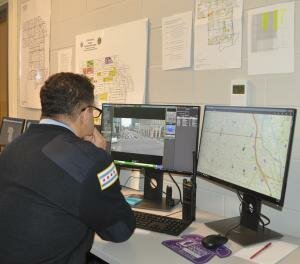
Officer Velez is sitting at the two-monitor computer where OEMC calls, cars and cameras may be accessed
OEMC, CPD and civilians
Calling "911" and "311" is often described by civilians as an experience to avoid. However, OEMC is part of the a three way partnership that needs to work well to make Chicago safe.
Officers Rivera and Edwards suggest that when placing a call to OEMC, it may be a better experience if the following facts are remembered:
- Each OEMC operator has a template of questions
- If the caller says they want to be anonymous, their name and contact information will not go over the air or go on the record given to officers
- Each call is assigned a priority number
- The template aids operators in determining the calls priority
- The highest priority is given to "in progress" situations
- Operators will ask specific questions which calls may seem irrelevant but are used in determining priority
- Officers do not see calls until CPD dispatch processes the call(s)
- Call is dispatched dependent on manpower and priority number
- It is possible that officers will be called off a call because a higher priority call requires their service
- Officers do knock on neighborhood doors for some cases. When they do that the anonymous caller may be among them. But that is done not because they called but because they are one of the neighbors