CHA commitment to "Keeping the Promise": challenged and refuted

Some of the residents at the press conference
With $450 million dollars of taxpayers' money sitting in their bank account, Chicago Housing Authority (CHA) has been forcing individuals and families with children, along with seniors and the disabled into the streets since October 1999.

Children are part of those in need of housing
Many of those people told their stories as more and more people crowded into the 2nd floor press area in Chicago's City Hall Wednesday morning, Feb. 1. It was a prelude to the City Council's Committee on Housing and Real Estate meeting regarding the "Keeping the Promise" ordinance, later in the morning.
In 1996, Mayor Richard M. Daley negotiated with the U.S. Department of Housing and Urban Development (HUD) to enroll the CHA in the deregulation program known as "Moving to Work." That program severely curtails HUD’s ability to oversee CHA on a wide range of performance and budget issues. Some say that in essence, CHA has no oversight.
CHA is reportedly asking the U.S. Department of Housing and Urban Development (HUD) for a ten-year extension under the "Moving to Work" program from 2018 to 2028.
"Keeping the Promise"* is about the promise made to the thousands of people displaced from their homes which were torn down or closed up. They were given the right to go back to their homes after they were constructed or renovated.

Joyce Bell and Alphonso Jones
Resident objections
"It has been 16 years and they [residents] still have not been allowed to return," said resident Alphonso Jones, who is with the Kenwood Oakland Community Organization.
"What they [CHA] are doing is selling off the land and doing land swaps with such businesses as Mariano's and WalMart, charter schools and others. Their job is to provide a safety net for low income families but they are not doing their job. They are increasing the homeless by not filling existing units. They are ignoring the fact that we have children living on the street because they are not doing their job."
"Between 2005 and 2015, the CHA operated using only 75% of the available housing vouchers that they had. These vouchers could have been given to thousands of people who needed them like myself," said Joyce Bell from the One North Side organization. "I have been told that CHA has accumulated $450 million dollars.
"in October 2014 there were 282,000 households eligible to apply for a chance to get on a housing waiting list. Often people do not even know about those chances and yet the signup period is only 30 days. And, getting on a list does not guarantee that you will ever get housing."
It was also pointed out that there are available units but they go unoccupied. Repeatedly people said that CHA needs to be responsible and transparent and they need oversight.
The proposed ordinance is to cover these issues and also requires CHA to spend 97% of their available funds for its voucher program or services for voucher-holders within three years of the ordinance passing.
Other points are addressed in the "Keeping the Promise" ordinance as well. The ordinance is co-sponsored by 25 alderpersons***, 30 diverse community-based organizations, good government groups and fair housing advocacy centers. It was introduced in July 2014.
What are the stories?
Several stories were shared by those living or trying to live in public housing as well of a couple of aldermen.
Those in search of housing

Linda Diaz (center)
Linda Diaz, born and raised in Chicago, became disabled at age 13. She lived in Humboldt Park and eventually inherited the family home which was free and clear of debt. "My parents thought they had left me a permanent place and a secure asset," she said.
"Upon their death, there was no longer a senior exemption on property taxes and the taxes increased and increased. Then someone bought my tax debt."
With the loss of her home came severe depression during 2008 when the economy tanked and she could not find employment. Unable to keep up with the taxes, "at one point, I squatted in my home because I didn't want to give it up. I lived through two winters without heat. Eventually I did end up on the streets, losing the home that my parents once thought was so secure…losing my American dream…and theirs.
"Because of new rules about how long people can remain in shelters, I am being told that on March 1 I have to leave the shelter where I've been for two years. I might be on the street again. I've been looking for housing for over two years. I am still on many lists for the CHA and other affordable buildings."

Erika Weaver
Having been admitted to law school in Chicago in March 2013, Erika Weaver felt that she had a new lease on life. She was going to move her family of three children from Mattoon, IL to Chicago.
She thought moving into CHA would not be difficult under a Mobility Program. Working with a realtor, she decided that the best locations would be Hyde Park and Lincoln Park. They were safe communities with good schools and access to transportation. By August 2013 she still had not located an apartment and decided to put off going to school while she concentrated more on locating an apartment in various Chicago neighborhoods.
Considered to be an excellent candidate for apartments, her opportunities evaporated when the landlord learned that she was on a voucher program. "I faced endless discrimination," she explained.
"It is very disheartening when you are turned down in areas where you want to live and told to move into areas where there are high rates of crime, food deserts and/or have no public transportation access.
After a year of searching and sleeping on other people's sofas, "I had exhausted everything...my finances, my energy, my hope, my emotions and my children. I could see the affect of our family being rejected again, and again and again," Weaver explained. She informed CHA in January 2015 that she was giving up.
"Today, I am still on my journey to raise my family up into a better economic place. I am in my second year at Law School, but, please understand, to attend law school and to keep my family in a neighborhood I know to be safe and have good schools has required me to commute every Sunday night nearly 200 miles from Mattoon into Chicago to attend classes; live separate from my children for nearly half the week; sleep on the couches of generous individuals while in Chicago, and then commute back Wednesday night to Mattoon to reunite with my children."
Aldermen share their backgrounds
Walter Burnett, 27th Ward Alderman, said that when he was born in Rockwell Gardens, his dad worked in a grocery. They needed low income housing and were put in Cabrini Green.
Comparing then to now, Burnett said, "Market rate housing is now $3 a square foot. That is $3,000 per month for 1,000 square feet…that is insane! Who can afford a $3,000 apartment that is barely a one-bedroom for 1, 2, 3 and 4 people. We need more low income housing."

James Cappleman
James Cappleman, 46th Ward Alderman, said that in 1968 his dad died, "unexpectedly leaving my mom to raise eight children alone. We lived paycheck to paycheck.
"When I graduated from high school in 1971, my mom said that if I wanted to go to college I had to pay for it all on my own.
"In '71, I got a job in the produce department of a grocery store and lived with three roommates. Our total rent was $200 per month. I graduated from college and the total for tuition and books was $1,600.
"I could work part-time, go to college and graduate with zero debt. Today people are working two or three jobs just to pay their monthly rent. Today, 40% of the wealth is owned by 1% of the population…it is NOT SUSTAINABLE!
"Chicago has to do its part. When we address those needs, we all do well," Cappleman concluded.

Deb Mell
Demands for CHA doing their job
Deb Mell, 33rd Ward Alderperson, emphatically pointed out that "we can fix this and we don't need Springfield or a tax increase. Unlike other City and State structures, the CHA has money. They are debt free, its pension system is solvent and they are sitting on millions of dollars that should be used to break the cycle of poverty.
"In my area we are seeing a lot of gentrification and I feel that we are losing the fabric of neighborhoods and we need to keep that in tact," she concluded.
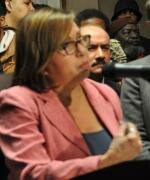
Milly Santiago
"Two weeks ago," said 31st Ward Alderperson Milly Santiago,"ten people were being forced out of a building in mid-winter because the building was sold. There are seniors, kids and people with vouchers in that building.
"We stepped in and they can stay there until the end of March, but what then?...It is about dignity too."
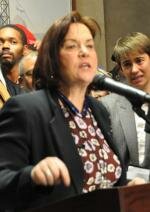
Susan Sadlowski Garza
From the 10th Ward, Susan Sadlowski Garza, said, "When we stand up and fight back, we win and for that I am proud."
Nine months ago, one of her constituents was kicked out of her "affordable" home. However CHA has been sending that landlord a check even though she doesn't live there. "We can not be a city that doesn't put a roof over people's heads…that is despicable," said Garza.
Lathrop Homes is another example of this type of incompetent management. The CHA receives $10,000 per unit annually. There are 925 units and most of the units are not occupied nor have they been. However, the CHA has been paid by the Federal government as though they were completely occupied of years. That is $925 million annually.

Harry Osterman
Harry Osterman, 48th Ward Alderman, said, "This morning there were people who woke up under viaducts. There are children that walk to schools with empty stomachs.
"We can not be a world class city with conditions like that. Those issues affect everyone in the City's 77 communities. It is not a Southside, Westside, East or Northside problem, it is a Chicago issue and we need to deal with it.
"This is CHA's moment…they need to step up now, keeping the City diverse not one of haves and have-nots."

Proco "Joe" Moreno
"We talk about affordable developments but they are not just developments, they are where people live and raise their families," said 1st Ward Alderman Proco "Joe" Moreno, who was the lead on the Keeping the Promise Ordinance.
"CHA has had five CEOs in five years, yet I don't know of any other entity that can say that they are cash rich today in the City or State. CHA can."
Committee on Housing and Real Estate meeting
Chaired by Joe Moore (1st ward), the Committee on Housing and Real Estate's meeting lasted until just before 9 p.m. There was no vote as it was determined to be a "subject matter hearing." There also was no time limit per speaker.
Nine of the 12 member Committee members were present, according to reports. They were: Joe Moore (1st), Pat Dowell (3rd), Gregory Mitchell (7th), Sue Sadlowski Garza (10th), Raymond Lopez (15th), David Moore (17th), Walter Burnett, Jr. (27th), Chris Taliaferro (29th) and James Cappleman (46th). Not present were: Joe Moreno (1st) John Arena (45th) and Harry Osterman (48th). The number dwindled to six by the end of the meeting.

Leah Levinger and Alphonso Jones
Starting with approximately 350 people attending the meeting, it dropped to 200 in two hours then down to 150 by the time the public testimony began, reported Leah Levinger, Chicago Housing Initiative. With public input starting at 2:30 p.m., 35 individuals spoke which included seven or eight against the ordinance and the rest in favor.
Three of the nine committee alderpersons (Garza, Lopez and David Moore) asked several questions. Garza and Lopez zeroed in on financials while David Moore targeted whether CHA has been or will be honoring its historic commitment to communities regarding redevelopment.
Complaints against CHA expressed during the press conference and elsewhere rolled into two major points: providing public housing and being transparent with their financials.
Giving some historic background, Julia Stasch, a former CEO of CHA and Mayor Daley's former chief of staff spoke about what has happened since the introduction of Daley’s Plan for Transformation in 1999.
The new CEO of CHA, Earl Jones, was one of the major opponent's of the Ordinance. He painted a different picture than most supporting the ordinance. In general, he said that they have experienced, talented and committed staff and that they had accomplished a great deal.
The surplus, according to Jones, was from 2008. He pointed out that they closed out 2015 with a surplus of $221 million but that they expect that by 2017 they will close in a deficit because of projects scheduled over the next two years.
Speaking against Jones' statement, Amanda Kass, Center for Tax and Budget Accountability (CTBA), said that based on CTBA's analysis of CHA's 2008-12 budgets, CHA used its surplus monies to pay down their indebtedness early. Saying that while that action will result in future savings, it is questionable whether that money should have been spent in that pay down when tens-of-thousands were on the waiting list for housing vouchers and public housing.
Public housing resident and President of CHA’s Central Advisory Council, Francine Washington said that considering that more aldermen than CHA board members have gone to jail for corruption, City Council has no business getting involved in CHA's work.
Washington went on to say that aldermen had not listened to public housing residents' needs and that finally CHA has a leader [Jones] who knows what he's doing.
On the contrary said Aldermen Lopez, the ordinance should go further. Together with Alderman Reboyras, they pointed out Hispanics have had exceptional difficulties getting vouchers in Latino communities, because there are so few options.
“We’re still short of 2,000 units from the Plan for Transformation that they said they were going to give us then [1999]. We listened to CHA when they said that they had a plan, now it’s six years past due, and we’re just asking in this ordinance for a written promise. We don’t need CHA stockpiling money, we need accountability for what’s done with this money. We need accountability,” said Edda Davis, a Dearborn Homes resident, quoted by AlderTrack's Claudia Morell.
“We don’t need more ‘affordable housing,’ we need more low income and public housing. I’ve done the math on what you call affordable housing, and I ask you today, affordable for whom? It’s not for us.”
The meeting ended at approximately 9 p.m.
*Copy of the revised ordinance from Alderman Moreno's office
**What is "Keeping the Promise"
The intent of the Keeping the Promise Ordinance is to protect subsidized housing. The path to that is to:
- Compensate for the problems caused by federal deregulation of CHA by creating a local oversight structure and city standards for CHA’s performance
- Prevent further net loss of low-income housing, especially in Opportunity Communities
- Improve housing quality in voucher program & voucher-holder access to all communities
- Ensure full use of available housing vouchers
- Encourage CHA to follow through on commitments to rebuild demolished public housing
- Create safeguards against privatization and displacement during any RAD conversions
How is it to work?
It is to change policy through:
- Transparency and Quarterly Reporting: CHA will report quarterly to the Committee on Housing and Real Estate on its vacant and offline housing ward-by-ward, its voucher utilization rate, its progress building replacement public housing, available funds, and the number of section 3 jobs created to help low-income families progress economically.
- Required One-for-One Replacement of Standing Low-Income Housing Units: The Committee on Housing and Real Estate will not authorize City funding for developers to redevelop a public housing project unless the Master Plan demonstrates how all standing units CHA proposes to demolish or convert will be replaced on a one-for-one basis.
- Enforced CHA Commitments to Rebuild Replacement Housing: The City will not participate in land swaps of City land or approve Planned Development Applications for the disposition of CHA land until CHA produces a Replacement Housing Plan showing the location, financing and timeline for constructing all replacement housing units promised at time of demolition. Certificates of Occupancy for market units will only be released by the City as public housing units come online. If the replacement housing promised is not produced, the City has the right to recapture grant funds given to CHA/ its developer.
- Encouraging CHA to Fully Utilize All Available Voucher Funding: City Council will make future funding to CHA projects conditional on CHA utilizing 97% of the funding CHA receives for its voucher program on services for voucher-holders and additional vouchers. Less administration costs and additional funds for services, CHA receives enough federal funding to circulate 8,000-9,000 more vouchers than it circulated in 2013.
- Protecting voucher-holders from discrimination: The ordinance allocates $1 million annually to enforce the law protecting voucher holders from discrimination by landlords.
- Improving housing quality and voucher-holder access to opportunity communities: Increase resources for mobility counseling so voucher-holders can access all neighborhoods.
- Creating safeguards against privatization and displacement in any R.A.D. conversions: Preserve public ownership and control of public housing developments slated for Rental Assistance Demonstration (RAD) conversions and safeguard residents’ rights to return and rights to organize.
Proco Joe Moreno (1st), Leslie Hairston (5th), Roderick T. Sawyer (6th), Susan Sadlowski Garza (10th), Toni Foulkes (16th), David Moore (17th), Howard Brookins, Jr. (21st), Ricardo Munoz (22nd), Daniel Solis (25th), Roberto Maldonado (26th), Walter Burnett, Jr. (27th), Chris Taliaferro (29th), Ariel Reboyras (30th), Milly S. Santiago (31st), Scott Waguespack (32nd), Deb Mell (33rd), Carlos Ramirez-Rosa (35th), Gilbert Villegas (36th), Nick Sposato (38th), Michele Smith (43rd), Tom Tunney (44th), John Arena (45th), James Cappleman (46th), Ameya Pawar (47th) and Harry Osterman (48th).
| Attachment | Size |
|---|---|
| CLEAN COPY KTP Substitute Ordinance 2-17-2016.pdf | 180.13 KB |