The devil is in the details for proposed BRT route on Ashland Avenue
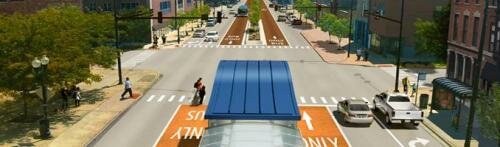
Proposed street configuration
While the selection of Ashland Ave. by The Chicago Dept. of Transportation (CDOT) and Chicago Transit Authority (CTA), for Chicago's third Bus Rapid Transit (BRT) route sounds exciting, the devil is in the details. In this case, the devil includes reduction of two lanes of traffic, providing one lane of traffic in each direction; no left turns; reduction of parking by 8% and loading zones by 4%; and no bike lanes. Answers about the details are to be studied this year in the Concept Engineering phase..
According to CDOT and CTA, transportation and community development advocates and local leaders praised the plan as an important milestone in Chicago’s BRT vision that balances the needs of all street users, improves quality of life in local neighborhoods, provides better access to jobs and services, and makes local streets more attractive, safer and less congested. There were 6 open houses and other stakeholder meetings about this vision but apparently details were not included.
A faster more reliable surface transportation route in the middle of Ashland Ave. will also provide better connections with other transportation routes and other communities, according to Peter Skosey, Executive Vice President, Metropolitan Planning Council (MPC).
While the intent of this plan is to have the center-running route go from Irving Park to 95th, the initial phase is to go from Cortland to 31st. This year is to be spent in the Concept Engineering phase. Construction is to begin in 2014 and service would begin in 2015.
The initial construction is to connect transit riders to the Metra and the Blue, Green, Orange and Pink lines. While regular buses average 8.7 miles per hour on Ashland, the plan includes center-running bus-only lanes, full-service transit stations and high-tech traffic signals that could make the BRT service nearly as fast as the Red Line while largely avoiding street congestion.
"By reinventing the bus and rethinking our streets, BRT can bring dramatic improvements to public transit," said Ron Burke, Executive Director, Active Transportation Alliance (ATA). “BRT is an incredible opportunity to provide the kind of transportation options that Chicagoans need."
When asked about the lack of bike lanes, Lee Crandell, ATA Director of Campaigns said, "The Chicago Streets for Cycling Plan 2020 and the BRT plan will connect public transportation with safe bike routes providing people better ways to get around."
When thinking about what this project will do to one of the two main north-south streets (Ashland and Western) that go from one end of the city to the other, many questions come to mnd:
- How can one lane of traffic accommodate the traffic that currently runs congested on two lanes during rush hours and on weekends?
- What will happen to the commercial traffic that uses that street?
- With one lane, how do emergency vehicles transverse the street?
- How can drivers go east or west with "No left turns?"
- How can drivers get to a business on the opposite side of the street?
- What financial impact will there be on the businesses on the street? (Not just during construction but daily, if implemented.)
- Have there be traffic studies or impact studies to address these issues?
"The next step in this process includes public meetings. The CTA will do thousands of hours of traffic analysis along each segment of road and at each and every intersection, to determine the right configuration. Public and business input will be part of that process," explained Mandy Burrell Booth of MPC. No surveys or impact studies have been done to date.
In response to the "no left turn" question, Skosey said, "Left turns will be limited at most streets but not all. A couple of things will happen in their place. First, cars will make three right turns to get to their ultimate destination. Second, cars will pick a different approach route, not on Ashland. Third, cars will turn left on one of the few remaining left turn opportunities."
An additional question that answer brings up is about what the extra traffic does to streets that will end up with the additional traffic and the businesses or residents on those streets.
"New York city did this already on two main thoroughfares and found no significant delays and the happy consequence of less accidents as well. BRT and the associated street improvements are designed to move the most amount of PEOPLE not necessarily CARS," commented Skosey.